











Choosing an SSD supplier in China is about far more than finding the lowest quotation. For PC builders, distributors, system integrators, and OEM buyers, a supplier's manufacturing capability, component configuration, testing procedures, product consistency, and technical support directly affect the reliability of the final product.
A dependable supplier should provide clear specifications, representative samples, documented quality control, stable production, and batch traceability.
This practical guide explains how to identify, verify, test, and select an SSD supplier in China before releasing a bulk purchase order.
Quick Answer: What Should You Check in a China SSD Supplier?
Before placing a bulk SSD order, focus on manufacturing control, component transparency, sample validation, testing procedures, specification consistency, and after-sales support.
| Evaluation Area | What to Check |
|---|---|
| Supplier Type | Direct manufacturer with in-house SMT assembly vs. trading company |
| NAND & Controller | Original NAND Flash type, flash consistency, and controller model |
| Firmware | Firmware stability, validation, and configuration lock |
| Testing Standards | Functional testing, compatibility checks, and automated aging tests |
| Quality Control | IQC, line QC, and batch consistency |
| Samples | Pre-order sample validation on target hardware platforms |
| OEM Support | Custom branding, private labeling, packaging, and capacity options |
| Warranty & Support | Clear warranty terms, RMA procedures, and direct technical engineering support |
Why Source SSDs from China?
China is attractive for SSD sourcing not simply because of price, but because buyers can often access integrated electronics manufacturing, flexible capacity configurations, OEM support, and scalable production.
Flexible Product Lineups
Depending on the supplier, buyers may source:
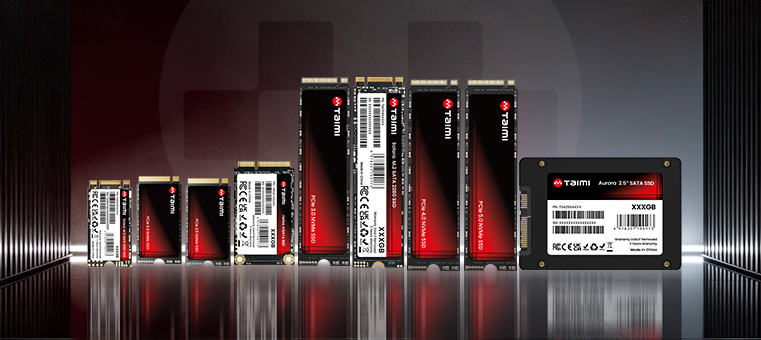
- 2.5-inch SATA III SSDs
- M.2 SATA III SSDs
- M.2 NVMe SSDs based on PCIe 3.0 and PCIe 4.0 platforms
- Different capacity options for PC, OEM, and bulk procurement projects
OEM and Bulk Procurement Support
For OEM projects and recurring bulk orders, buyers often need more than off-the-shelf products. They may require specific capacities, custom labels, retail packaging, or specific drive configurations.
A supplier with strong manufacturing coordination can better handle these requirements. For PC builders specifically, buyers can also review our guide on choosing an SSD supplier for PC builders .
SSD Manufacturer vs. Trading Company
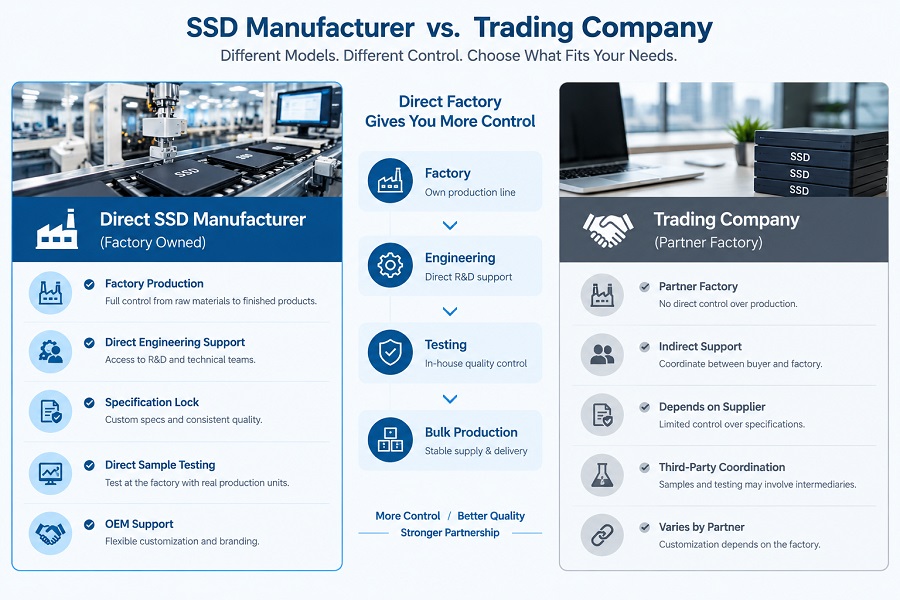
One of the first questions when evaluating an SSD supplier in China is whether the company is a direct manufacturer or a trading company working with partner factories.
For buyers sourcing SSDs in China, the important question is not simply whether a supplier calls itself a manufacturer. What matters is which production stages it controls, who owns the specifications, and who is responsible for quality when a batch issue occurs.
| Evaluation Area | Direct SSD Manufacturer | Trading Company |
|---|---|---|
| Production Control | Direct oversight of component screening, SMT assembly, programming, and testing | Dependent on third-party manufacturing partners |
| Technical Support | Direct engineering and factory communication | May require communication through an external factory |
| Specification Lock | Direct control of approved product specifications | Depends on third-party agreements |
| Product Customization | OEM labeling, packaging, and project-specific requirements | Depends on partner factory capabilities and MOQs |
| Sample Coordination | Direct factory validation and coordination | Additional coordination with manufacturing partners may be required |
For a broader supplier evaluation framework, see our guide on how to evaluate an SSD supplier before moving to sample testing.
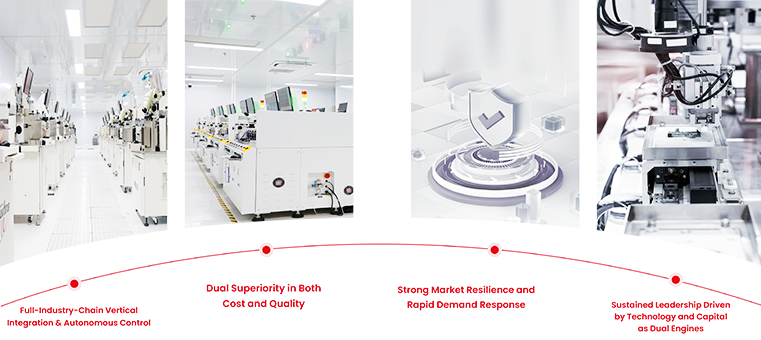
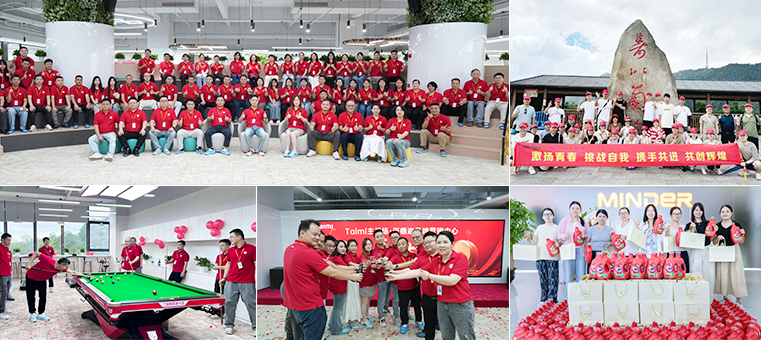
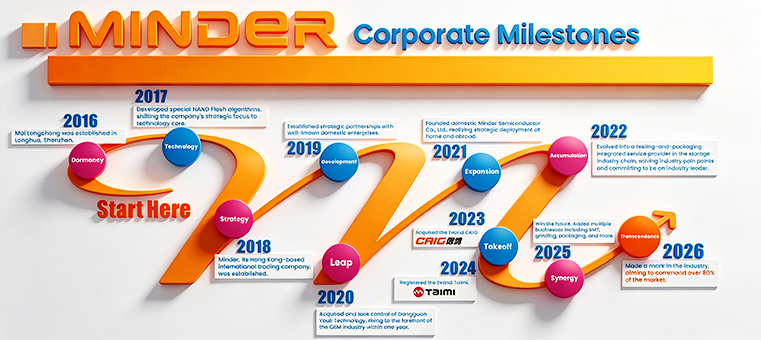
As an integrated storage manufacturer, Taimi manages key stages of the SSD production workflow, from component screening and SMT assembly to programming, testing, and final inspection, helping support traceability and consistency across production lots.
Typical SSD Specifications for Bulk Buyers
The following table shows typical specifications from Taimi's consumer SSD lineup for reference. Exact specifications should always be confirmed against the applicable product datasheet before placing an order.
| Specification | 2.5" SATA III SSD | M.2 NVMe PCIe 3.0 x4 | M.2 NVMe PCIe 4.0 x4 |
|---|---|---|---|
| Form Factor | 2.5-inch 7mm | M.2 2280 | M.2 2280 |
| Interface Protocol | SATA III 6Gb/s | PCIe Gen3 x4, NVMe 1.3 | PCIe Gen4 x4, NVMe 1.4 |
| Capacity | 128GB–2TB | 256GB–2TB | 512GB–2TB |
| Max. Sequential Read | Up to 550 MB/s | Up to 3500 MB/s | Up to 7000 MB/s |
| Max. Sequential Write | Up to 500 MB/s | Up to 3000 MB/s | Up to 6000 MB/s |
| NAND Flash Type | 3D TLC/QLC | 3D TLC | 3D TLC |
| Operating Temperature | 0°C to 70°C | 0°C to 70°C | 0°C to 70°C |
| Customization | OEM labeling and packaging options depending on project requirements | OEM labeling and packaging options depending on project requirements | OEM labeling and packaging options depending on project requirements |
If your project specifically requires NVMe storage, our guide to choosing an NVMe SSD supplier provides additional procurement considerations.
For buyers sourcing 2.5-inch SATA drives, our guide to choosing a 2.5-inch SATA SSD supplier covers additional considerations for bulk orders.
How to Verify an SSD Supplier in China
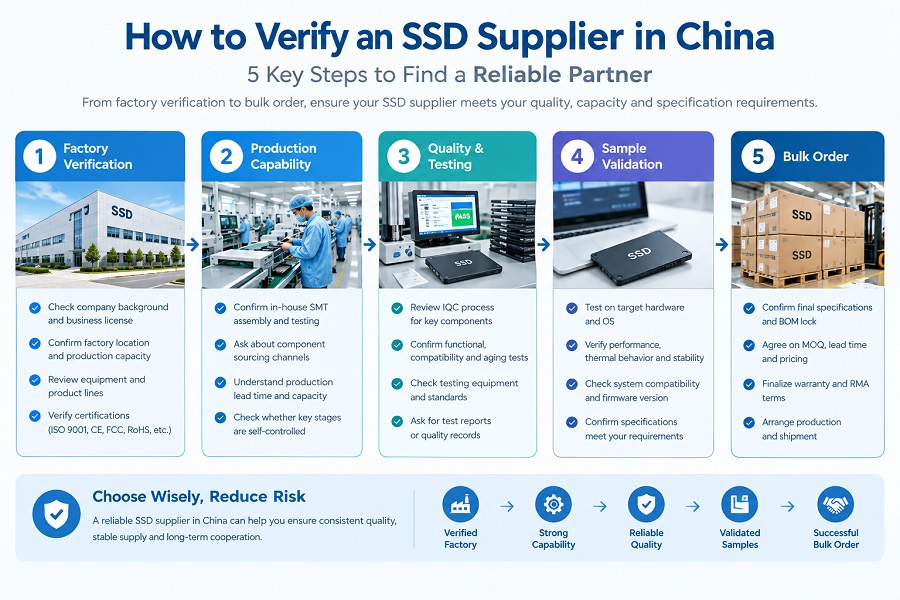
Before requesting a quotation, evaluate the supplier's manufacturing background, production responsibilities, technical capabilities, and quality-control procedures.
1. Check Manufacturing Capabilities
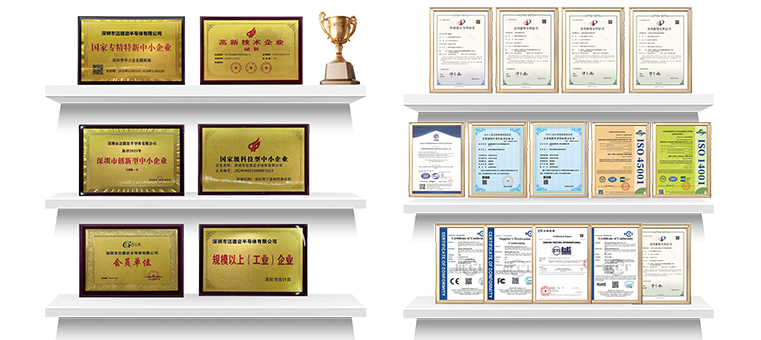
Review the company's history, factory location, production capacity, equipment, product lines, and applicable certifications such as ISO 9001, CE, FCC, or RoHS.
2. Confirm Production Responsibilities
Ask who handles assembly, whether key production stages are performed in-house, where functional and aging tests are conducted, and who controls firmware and component specifications.
3. Review Testing and Quality Control
- IQC: Quality verification of NAND, memory chips, controllers, and other incoming components.
- Burn-in & Thermal Testing: Automated aging tests used to screen early-stage hardware faults according to product requirements.
- Compatibility QC: Validation against target host platforms and operating systems.
4. Confirm Traceability and Warranty Terms
Ask whether the supplier can provide lot numbers, serial tracking, batch codes, warranty terms, and an RMA procedure. Traceability becomes especially important when sourcing the same SSD repeatedly over multiple production runs.
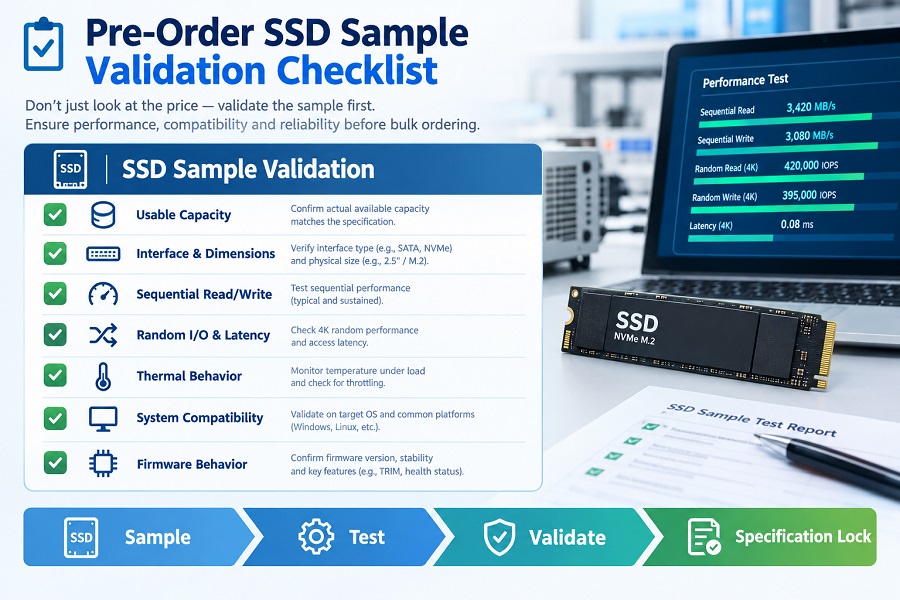
Pre-Order SSD Sample Validation Checklist
Never rely only on a supplier's datasheet or quotation when the SSD will be used in a recurring OEM or bulk project. Representative samples should be tested on the actual hardware platform whenever possible.
| Test Item | What to Check |
|---|---|
| Usable Capacity | Formatted capacity under the target operating system |
| Interface & Dimensions | Physical fit, PCB size, connector alignment, and form factor |
| Sequential Performance | Read/write performance across benchmark tests |
| Random I/O & Latency | Responsiveness under multitasking and representative workloads |
| Thermal Behavior | Temperature stability under heavier workloads |
| System Compatibility | Boot-up, sleep/wake behavior, BIOS detection, and operating-system recognition |
| Firmware Behavior | Drive detection, basic health reporting, and performance stability |
Simple Sample Validation Workflow
1. Compatibility Testing
Test the sample on the exact motherboard chipsets, host systems, and operating systems expected in the final application.
2. Performance Validation
Check both peak and sustained performance. Short benchmark bursts may not represent how the drive behaves during longer workloads.
3. Firmware Consistency
Confirm that the validated firmware configuration will be maintained in bulk production. For a deeper explanation of the role firmware plays in SSD performance and compatibility, see our guide to SSD firmware .
Why Buyers Partner with Taimi: Our Core Advantages
In-House Manufacturing Control
Key production stages from component screening and SMT assembly to programming and final inspection are managed directly.
Strict BOM Locking Policy
Approved controller, NAND type, and firmware configuration can be locked for future production runs according to the project specification.
End-to-End Testing Protocols
Production lots can undergo IQC, functional testing, compatibility validation, and automated burn-in according to product and project requirements.
Flexible OEM & Private Labeling
OEM support can include customized logo printing, packaging designs, and capacity configurations according to project requirements.
What to Confirm Before Placing a Bulk Order
- Specification Lock: Confirm NAND type, controller, firmware, capacity, and performance requirements. Any future specification changes should be agreed in advance.
- Quality & Inspection Criteria: Agree on acceptable quality limits, inspection standards, and testing requirements.
- Commercial Terms: Confirm MOQ, lead time, warranty, packaging, shipping terms, and payment conditions.
Red Flags When Choosing an SSD Supplier
- Unclear NAND or controller details
- Unrealistic speed claims beyond interface bandwidth
- No sample testing allowed before bulk orders
- Unannounced specification changes between batches
- Vague warranty, RMA, or batch traceability procedures
Final Buyer's Verification Checklist
- Verified manufacturer vs. trading company
- Confirmed NAND, controller, and firmware configuration
- Tested samples for compatibility, performance, and thermal behavior
- Agreed on specification lock and batch consistency
- Confirmed warranty, lead times, and RMA procedures
- Finalized MOQ, custom packaging, and labeling requirements
Final Verdict
Choosing an SSD supplier in China should not be based on price alone. Evaluate the supplier's manufacturing capabilities, component transparency, sample performance, testing rigor, and technical support before placing a purchase order.
For OEM and recurring bulk projects, partnering with a supplier that can deliver consistent product specifications across orders is essential for long-term project success.
Planning your next bulk SSD order?
Contact the team at Taimi to discuss your project requirements or request validated samples for your target platform.
Request SSD SamplesFrequently Asked Questions
1. How can I confirm if an SSD supplier is an actual manufacturer?
Ask detailed questions about manufacturing capabilities, factory location, production equipment, testing procedures, and quality control. You can also request a factory audit, production video, or factory walkthrough when appropriate.
2. Why is sample testing necessary before placing a bulk SSD order?
Sample testing helps verify physical compatibility, performance stability, thermal behavior, and system behavior before the buyer makes a larger financial commitment.
3. What does “specification consistency” mean for bulk SSD orders?
Specification consistency means that future production batches follow the same approved product configuration, including the validated NAND, controller, firmware, capacity, and agreed performance requirements, unless changes are approved in advance.
4. What should be included in an SSD supplier specification agreement?
The agreement should clearly define the approved NAND, controller, firmware, capacity, performance targets, testing requirements, packaging, warranty terms, and procedures for approving future specification changes.