
Company Introduction
More












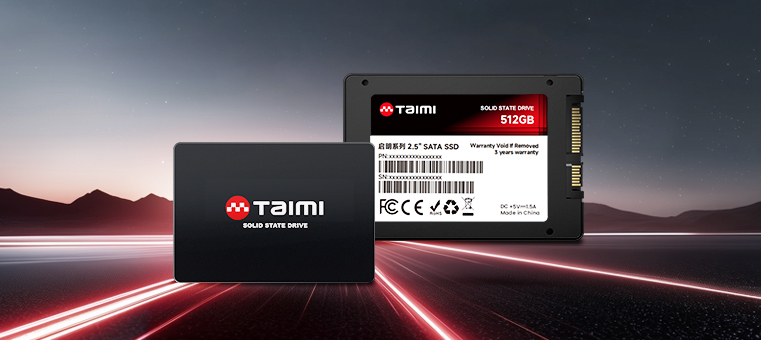

1TB SSD Price in 2026: SATA vs NVMe & Bulk Costs
Share:
The price of a 1TB SSD in 2026 varies depending on its interface, NAND flash type, controller, performance, brand, and sales channel. A 2.5-inch SATA SSD is generally positioned differently from an M.2 NVMe SSD, while PCIe 3.0 and PCIe 4.0 models can also have different price and performance profiles.
For buyers comparing storage products in markets such as India and Brazil, retail prices provide a useful starting point. However, businesses purchasing SSDs in bulk need to consider additional factors, including product specifications, order volume, component costs, quality requirements, and supplier capabilities.
Quick Answer
The price of a 1TB SSD in 2026 depends mainly on whether it uses SATA or NVMe, its PCIe generation, NAND flash, controller, and brand. Recent retail listings show that 1TB-class SATA SSDs in India can start at around ₹11,000–₹12,500, while selected NVMe models have different price points depending on their specifications. In Brazil, selected 1TB NVMe models are listed from approximately R$1,149.99. For bulk buyers, the final cost also depends on order quantity, component configuration, testing requirements, and supply arrangements.
1. How Much Does a 1TB SSD Cost in 2026?
There is no single market price for a 1TB SSD. Retail prices vary by country, brand, interface, product generation, and retailer. Even SSDs with the same advertised capacity can have different prices because they use different controllers, NAND flash configurations, and performance specifications.
For example, a 1TB SATA SSD is designed around the SATA interface, while an NVMe SSD uses the PCIe interface and can offer substantially higher sequential transfer speeds. Within the NVMe category, PCIe 3.0 and PCIe 4.0 models also differ in performance and product positioning.
The following examples provide a snapshot of selected retail listings in India and Brazil. They are market references rather than fixed market averages or manufacturer quotations.
1.1 1TB SSD Price in India
| SSD Category | Example Retail Price | Reference |
|---|---|---|
| 1TB-class SATA SSD | ₹11,067–₹12,499 | Selected SATA listings |
| 1TB PCIe 3.0 NVMe SSD | Around ₹15,040 | SK Hynix PC601 listing |
| 1TB PCIe 4.0 NVMe SSD | From around ₹12,760 | Selected PCIe 4.0 listing |
These examples show why buyers should compare individual product specifications instead of assuming that every NVMe SSD costs more than every SATA SSD. A particular PCIe 4.0 model may be listed below a PCIe 3.0 model because of differences in brand positioning, product specifications, promotions, and retailer inventory.
For the latest available listings, buyers can compare prices through SSD Prices India and PCBuildCost.
1.2 1TB SSD Price in Brazil
| SSD Category | Example Retail Price | Reference |
|---|---|---|
| SATA SSD, approximately 1TB class | From around R$1,100 | Selected 960GB SATA listing |
| 1TB PCIe 3.0 NVMe SSD | Around R$1,199.99 | Selected PCIe 3.0 listing |
| 1TB PCIe 4.0 NVMe SSD | From around R$1,149.99 | Kingston NV3 listing |
Brazilian retail listings also demonstrate that the difference between SATA and NVMe pricing is not always straightforward. Some entry-level PCIe 4.0 products may be priced competitively, while established brands and higher-performance models can cost more.
For current Brazilian retail comparisons, see Cupoom's 1TB SSD price comparison.
Price note: The figures above are selected retail listing examples checked around November 24–25, 2026. Prices and stock availability can change. The Brazil SATA reference includes a 960GB product, so it should be treated as a near-1TB comparison rather than an exact 1TB price. Retail prices are not directly comparable with factory or bulk procurement quotations.
2. SATA vs NVMe SSD: What Is the Price Difference?
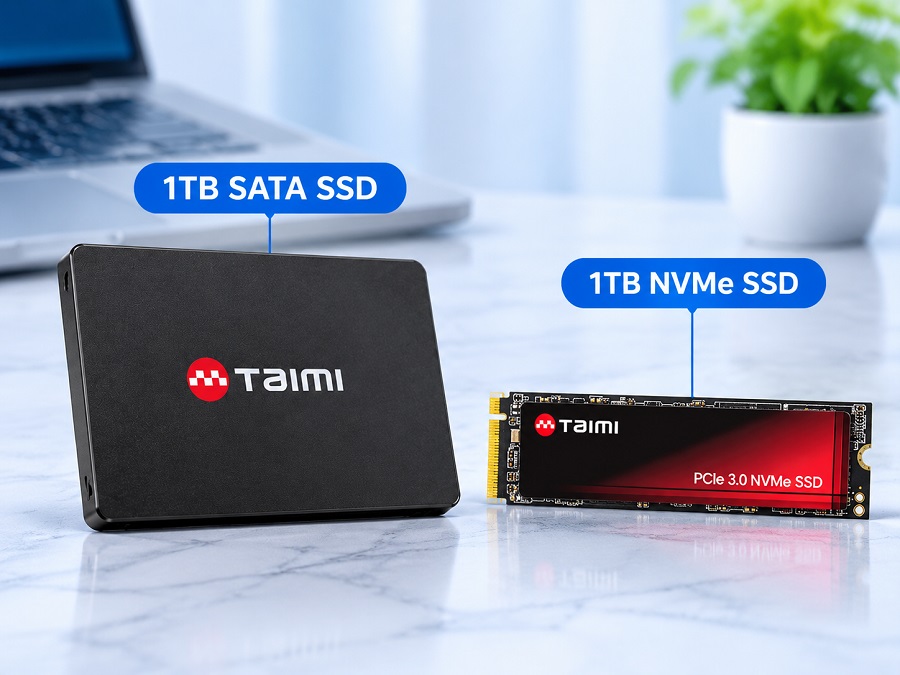
When comparing a 1TB SATA SSD with a 1TB NVMe SSD, the interface is one of the most important differences. SATA SSDs use the SATA III interface, while NVMe SSDs communicate through PCIe lanes and the NVMe protocol.
This affects performance, compatibility, and product positioning. However, the interface alone does not determine the final price. NAND type, controller, capacity configuration, brand, and market demand also matter.
| Comparison | 2.5-inch SATA SSD | M.2 NVMe SSD |
|---|---|---|
| Interface | SATA III | PCIe with NVMe |
| Typical Form Factor | 2.5-inch | M.2 2280 is common |
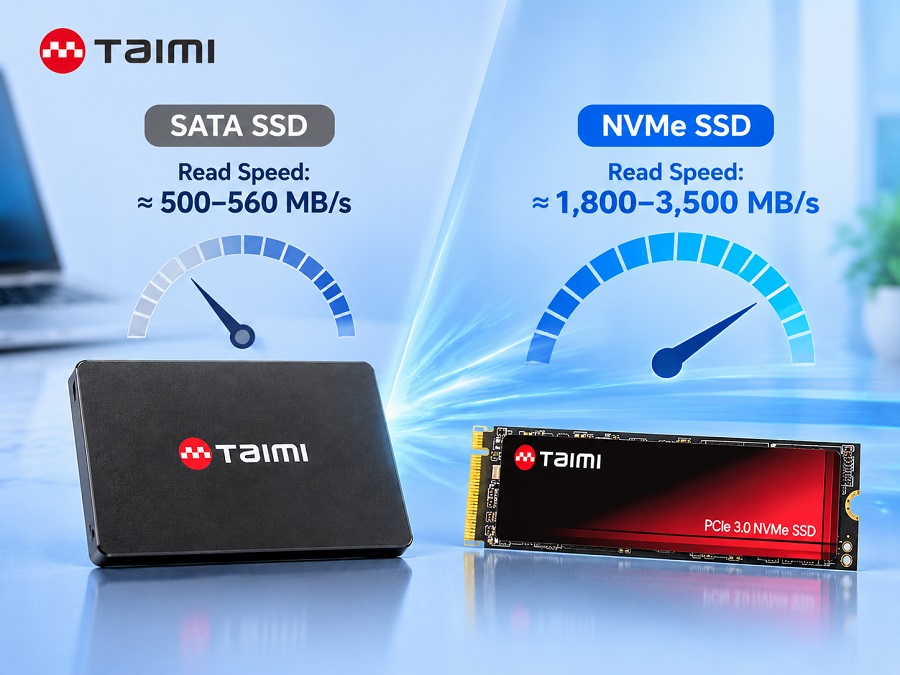
| Sequential Read Speed | Around 500–560 MB/s | Depends on PCIe generation and model |
| Compatibility | Requires a compatible SATA connection | Requires an M.2 slot with NVMe support |
| Common Applications | PC upgrades, laptops, general storage | Modern desktops, laptops, performance-oriented systems |
| Price Considerations | Depends on NAND, brand, and supply | Depends on PCIe generation, controller, NAND, and performance |
A SATA SSD can be a practical choice for upgrading older computers or systems that do not support NVMe. An NVMe SSD is more suitable when the target device supports PCIe storage and requires higher data transfer performance.
For businesses sourcing both product categories, the decision should be based on customer demand and device compatibility rather than interface specifications alone.
For a broader technical comparison, read PCIe vs. SATA SSD: A 2026 Engineer's Guide to Storage Upgrades.
3. PCIe 3.0 vs PCIe 4.0 NVMe SSD: Does a Newer Generation Always Cost More?
PCIe 4.0 offers higher theoretical bandwidth than PCIe 3.0. However, a newer interface generation does not automatically mean that every PCIe 4.0 SSD will be more expensive than every PCIe 3.0 model.
Retail prices are influenced by product positioning, NAND flash configuration, controller selection, brand, inventory, and promotions. This is why a lower-priced PCIe 4.0 model can sometimes appear below a PCIe 3.0 product in a retail comparison.
For bulk procurement, buyers should compare the complete specifications rather than relying on PCIe generation as the only pricing factor.
Important details to compare include:
- Maximum sequential read and write speeds.
- NAND flash type and configuration.
- Controller model and firmware.
- DRAM cache or DRAM-less design.
- Endurance rating and warranty conditions.
- Compatibility with the target system.
If you are sourcing PCIe 3.0 products for bulk orders, see PCIe 3.0 NVMe SSD Price: What Affects the Cost of Different Capacities?.
4. What Is Driving SSD Prices in 2026?
SSD pricing is closely connected to NAND flash supply, demand from consumer electronics and data center markets, manufacturer production decisions, and inventory levels across the supply chain.
In 2026, the NAND market has experienced changing supply-demand conditions. AI infrastructure and enterprise storage demand have influenced memory manufacturers' product allocation, while consumer electronics demand and distribution inventory have affected pricing in other segments.
4.1 NAND Flash Contract Prices and Retail Prices
Contract prices and spot prices do not always move in the same direction. Contract prices generally reflect supply agreements between manufacturers and customers, while spot prices reflect transactions in the open market.
In its November 19, 2026 update, TrendForce revised its forecast for overall NAND Flash contract price increases in the fourth quarter to 8%–13% quarter over quarter. It also reported that spot prices had recently corrected by more than 20% amid weaker demand and inventory-clearing pressure.
This difference matters because a decline in spot prices does not necessarily translate immediately into lower retail prices or lower costs for every SSD manufacturer. Existing inventory, purchasing contracts, component configurations, and distribution margins can delay or change the impact.
4.2 Supply and Demand
When demand for NAND flash increases faster than available supply, component costs can rise. Conversely, weaker demand or higher inventory levels can put downward pressure on spot prices.
SSD manufacturers and module suppliers need to monitor these changes when planning component purchases and production schedules. For distributors and bulk buyers, the timing of procurement can therefore influence the final purchasing cost.
4.3 Product Configuration
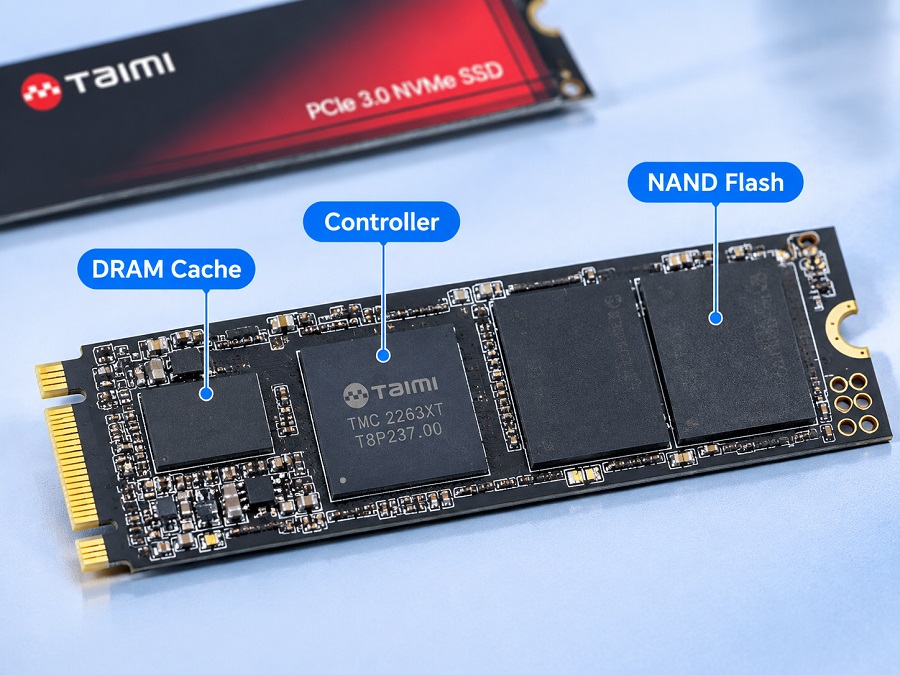
Two 1TB SSDs may have different costs even when they share the same interface and capacity. NAND flash type, controller, firmware, DRAM configuration, PCB design, and testing requirements all contribute to the product's overall cost.
For this reason, buyers should compare products with equivalent specifications when evaluating quotations from different suppliers.
5. What Affects the Cost of 1TB SSD Bulk Orders?
Retail prices are useful for understanding local market positioning, but they should not be used as a direct substitute for bulk procurement quotations. Manufacturers and suppliers calculate bulk order costs according to product configuration, quantity, component availability, testing requirements, and other commercial conditions.
5.1 NAND Flash Type and Controller
NAND flash is one of the major components affecting SSD cost. Different NAND types and configurations can have different performance, endurance, and cost characteristics.
The controller also influences product performance, firmware compatibility, and overall design. Buyers should confirm the agreed NAND and controller configuration rather than comparing quotations based only on capacity.
5.2 SSD Interface and Performance Requirements
A 1TB SATA SSD and a 1TB PCIe NVMe SSD are different product configurations. PCIe generation, target performance, controller selection, and firmware requirements can all affect the cost.
For buyers sourcing several product categories, it is useful to define the required interface and performance level for each model before requesting quotations.
5.3 Order Quantity
Order quantity is an important factor in bulk procurement. Larger orders may allow suppliers to plan production and component purchasing more efficiently, but the actual price depends on product specifications, component costs, available capacity, and order conditions.
Buyers should provide both their initial order quantity and estimated future demand when requesting a quotation. This helps suppliers evaluate the project more accurately.
5.4 Quality Control and Testing
Testing requirements should be included when comparing supplier quotations. Functional testing, performance verification, compatibility validation, aging tests, and batch inspection can affect production arrangements and overall cost.
A lower quotation is not necessarily the most cost-effective option if the product does not meet the required performance or reliability expectations.
For more details, see How to Compare SSD Supplier Quotes for Bulk Orders: 7 Key Factors.
5.5 Packaging, Warranty, and Delivery
Packaging requirements, warranty terms, labeling, shipping arrangements, and delivery schedules should also be confirmed before placing a bulk order.
For example, retail packaging and bulk packaging may involve different material and preparation requirements. Buyers should specify their preferred packaging format and destination market when requesting a quotation.
Bulk SSD Cost Checklist
- SSD capacity and interface
- NAND flash type and controller configuration
- Required read and write performance
- Order quantity and forecast demand
- Sample testing and quality requirements
- Warranty and after-sales arrangements
- Packaging, labeling, and delivery terms
6. How Should Businesses Compare 1TB SSD Suppliers?
For distributors, PC builders, and storage brands, choosing an SSD supplier involves more than finding the lowest price. A reliable supplier should be able to provide clear product specifications, consistent quality, and suitable production support.
Before placing a bulk order, consider the following points:
- Confirm the product configuration: Check the interface, capacity, NAND flash, controller, and performance specifications.
- Request samples: Evaluate product performance and compatibility in the intended systems.
- Review quality control: Understand the supplier's testing and inspection procedures.
- Compare quotations: Check whether different quotations cover equivalent specifications and services.
- Confirm warranty terms: Clarify the warranty period and after-sales process.
- Discuss production arrangements: Confirm lead time, order quantity, packaging, and delivery requirements.
For a more detailed purchasing guide, read SSD Wholesale Pricing: What Affects Bulk Order Costs?.
7. Why Consider Taimi for SSD Bulk Procurement?
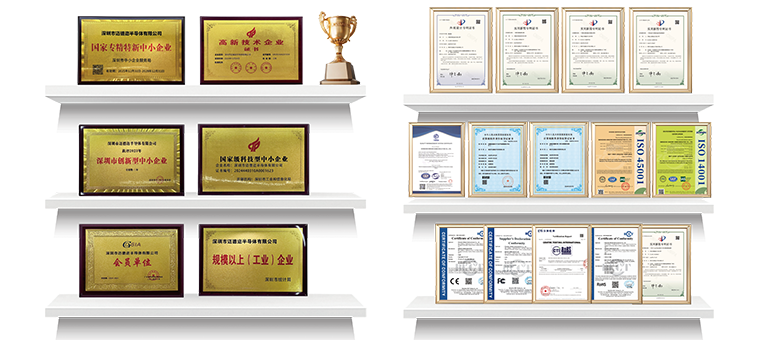
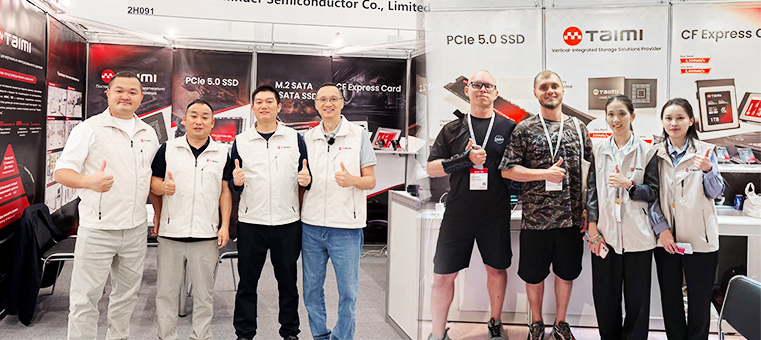
Shenzhen Minder Semiconductor Co., Ltd. operates under the Taimi brand and focuses on SSD product development and manufacturing. The company supports consumer-grade SSD projects and also offers enterprise-grade SSD products for relevant business requirements.
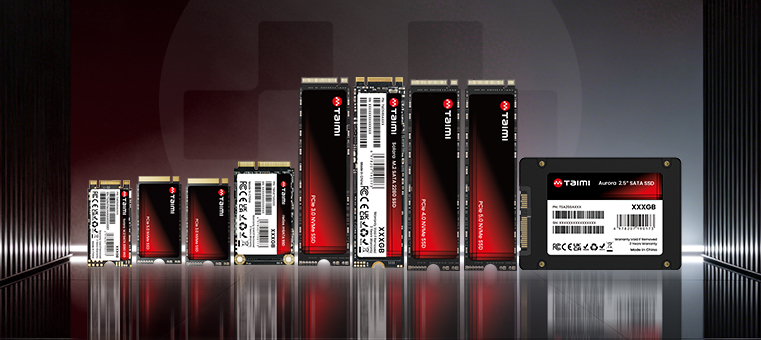
Taimi's product portfolio includes PCIe 3.0 NVMe SSDs, 2.5-inch SATA SSDs, M.2 SATA SSDs, mSATA SSDs, and other storage products.
For buyers sourcing 1TB SSDs or other capacities, product selection should be based on the intended application, interface compatibility, performance requirements, and target market.
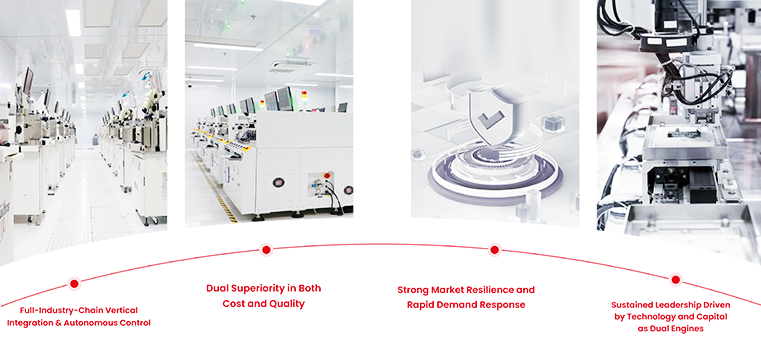
Taimi's manufacturing capabilities include:
- A manufacturing facility in Shenzhen covering more than 10,000 square meters.
- Eight automated SMT production lines.
- SSD production capacity of up to 800,000 units per month.
- Production processes covering assembly, programming, functional testing, and final inspection.
- Quality control activities including AOI, X-ray inspection, and product performance and compatibility validation where applicable.
- Support for sample evaluation, specification confirmation, and batch traceability requirements.
For PC builders, channel partners, and OEM projects, Taimi supports bulk procurement discussions based on the required SSD type, capacity, technical specifications, and project requirements.
Looking for 1TB SSDs for Bulk Procurement?
Whether you are sourcing SATA SSDs, PCIe 3.0 NVMe SSDs, or other storage products, Taimi can discuss your product specifications and bulk procurement requirements.
Share your required capacity, interface, estimated order quantity, and target market to start a discussion with our team.
Request a Bulk SSD QuoteContact Taimi to discuss SSD specifications, samples, and bulk supply requirements.
Frequently Asked Questions
Conclusion
The price of a 1TB SSD in 2026 depends on more than capacity alone. SATA and NVMe interfaces, PCIe generation, NAND flash, controller configuration, brand, and local market conditions all influence the final retail price.
For businesses purchasing SSDs in bulk, retail prices are only a reference point. A more accurate procurement comparison should consider the complete product configuration, order quantity, quality control, warranty, packaging, and delivery requirements.
By comparing equivalent specifications and working with a manufacturer that can clearly explain its product and production capabilities, buyers can make more informed SSD purchasing decisions.
Related Products
Recommended Articles
Consumer SSD vs Enterprise SSD: What Are the Differences?
2026-11-23
More
How Does SSD Garbage Collection Work? A Technical Guide
2026-11-20
More
Taimi 256GB SSD Bulk Price: 2026 OEM & Wholesale Guide
2026-11-18
More
PCIe 3.0 NVMe SSD Price: What Affects the Cost of Different Capacities?
2026-11-11
More
2.5-Inch SATA SSD Price: What Affects the Cost of Different Capacities?
2026-11-06
More
How to Import SSDs from China: A Step-by-Step Guide
2026-11-09
More
SSD OEM vs. ODM: Which Manufacturing Model Is Right for Your Business?
2026-11-02
More
SSD Manufacturing Lead Time: From Sample Approval to Bulk Delivery
2026-11-04
More
SSD Wholesale Pricing: What Affects Bulk Order Costs?
2026-10-26
More
SSD Read Speed vs. Write Speed: Key Differences and How to Compare Specs
2026-10-12
More
How to Choose a 2.5-Inch SATA SSD Supplier for Bulk Orders
2026-09-28
More
What Is an M.2 SSD? Form Factors, Keys & NVMe vs SATA Explained (2026 Guide)
2026-09-18
More